Last Updated on May 5, 2026 by Ellen
A thoughtful review of Garbage In, Faster by Claude Hanhart—why structured conversations may be the missing link between AI adoption and real results.
Posts may be sponsored. This post contains affiliate links, which means I will make a commission at no extra cost to you should you click through and make a purchase. As an Amazon Associate I earn from qualifying purchases.
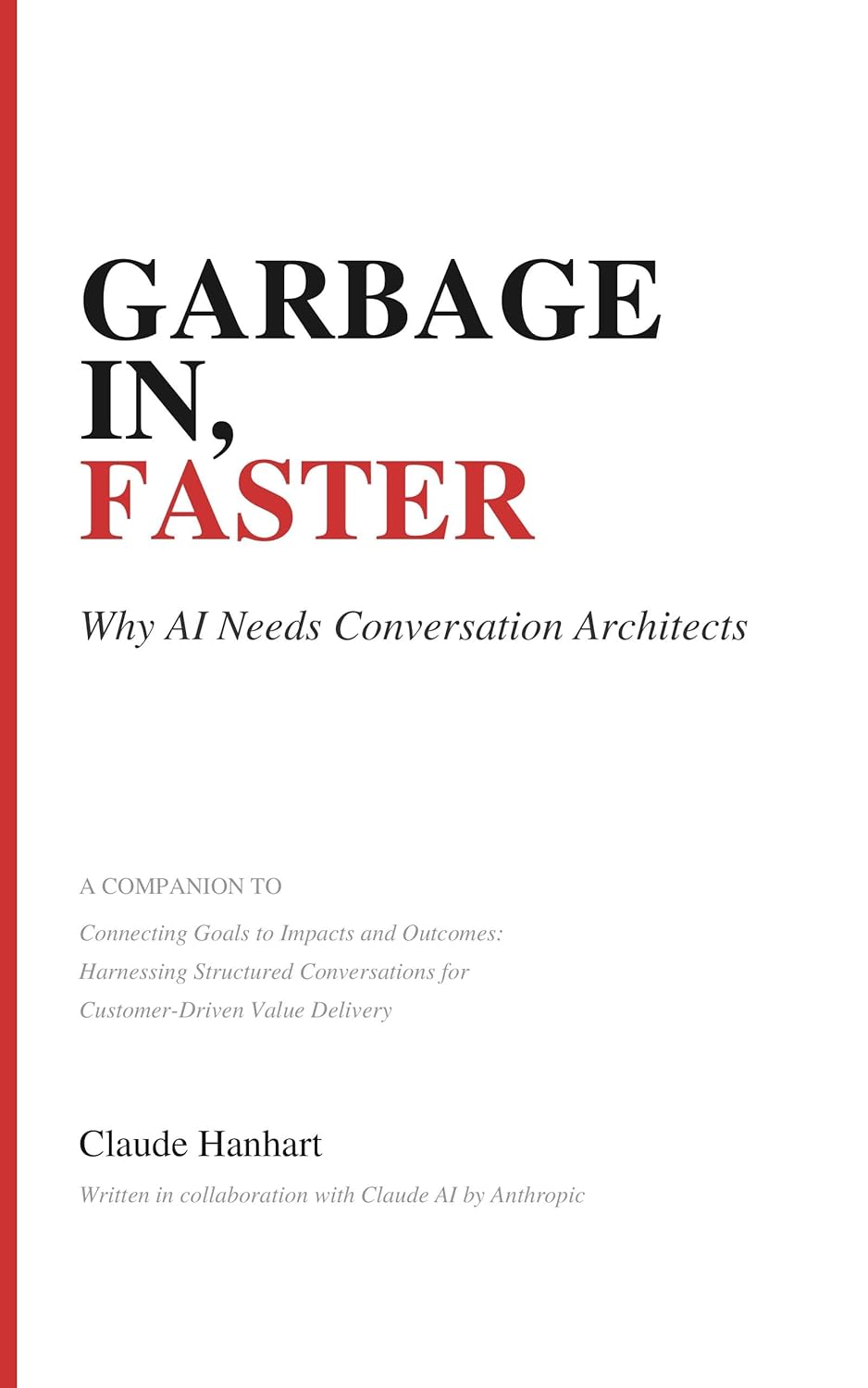
Garbage In, Faster Review: Why AI Still Needs Human Alignment
In Garbage In, Faster: Why AI Needs Conversation Architects (Structured Conversations), Claude Hanhart challenges one of the most common assumptions in today’s tech-driven workplaces: that artificial intelligence can replace the messy, human work of communication. Instead, he argues the opposite—AI doesn’t eliminate the need for alignment, it magnifies it.
This short but pointed read arrives at a moment when organizations are rapidly adopting AI tools while quietly shedding the very roles that once ensured clarity. The result, as Hanhart puts it, is simple and sharp: garbage in, faster.
About the Book
At the heart of this book is a paradox. Companies have invested heavily in AI systems designed to accelerate output, yet many are seeing diminishing returns. Hanhart traces this back to a missing layer: structured human conversation.
The book introduces the idea of “Conversation Architects”—people who design clarity before execution. Without them, AI becomes a force multiplier for confusion instead of productivity.
One of the standout concepts is “Communication Debt,” a term that feels instantly recognizable. Just like technical debt, it accumulates quietly—misaligned goals, vague instructions, unclear ownership—until it begins to erode outcomes. AI, rather than fixing this, accelerates the consequences.
Hanhart also reframes popular ideas in the AI space. “Context engineering,” often treated as a technical discipline, is revealed here as something far more human: the ability to ask better questions, define intent, and align meaning before tools are ever used.
The inclusion of practical frameworks—like the VERB + NOUN syntax—keeps the book grounded. These aren’t abstract theories; they’re simple structures that can be applied immediately, especially for teams overwhelmed by AI-generated outputs that look polished but lack substance.
[amazon box =”B0GKCH7GHF”]
Review
This is not a long book, but it is a dense one. Its brevity works in its favor, delivering a focused argument without unnecessary filler. The fact that the manuscript itself was generated in under 60 seconds using AI is more than a gimmick—it’s a living demonstration of the book’s central claim: speed is easy; clarity is hard.
Hanhart’s tone is direct, occasionally provocative, but never inaccessible. He challenges trends like “Agile is dead” without dismissing the frustrations behind them, instead pointing to a deeper failure in communication rather than methodology.
Where the book truly stands out is in its practicality. The “five conversations you can have Monday morning” concept makes it immediately actionable. This is especially valuable for:
* Product managers dealing with vague AI outputs
* Leaders questioning their AI ROI
* Former Agile practitioners redefining their role
If there’s a limitation, it’s that readers looking for deep technical AI strategies won’t find them here. But that’s also the point—this book deliberately shifts focus away from tools and back to thinking.
RELATED: The AI Ready Human
 About the Author
Claude Hanhart is a Product Strategist and Agile Coach with 10+ years of leadership experience in driving groundbreaking product strategies and agile transformations. His approach centers on fostering innovation rooted in business objectives, customer experience, and market leadership through tools such as Generative AI, OKRs, and Behavior-Driven Development (BDD).
Claude’s unique academic background – with an MA in Ancient Near Eastern Archaeology and Languages from the University of Berne in Switzerland and an MA in Geography from the University of Minnesota – brings an interdisciplinary perspective to modern product challenges. His multilingual abilities in German, Swiss German, and French have proven invaluable in international collaborations.
Structured Conversations represents Claude’s commitment to bridging strategic thinking with practical implementation. Currently based in New Jersey with his wife, Claude finds that their three energetic dogs serve as daily reminders about the importance of clear communication and patient guidance – principles that translate beautifully into his professional coaching work.
Conclusion
Garbage In, Faster: Why AI Needs Conversation Architects (Structured Conversations) makes a compelling case that the future of AI success isn’t just about better models—it’s about better conversations.
For anyone navigating the intersection of leadership, AI, and organizational clarity, this book offers a timely perspective: before you optimize outputs, you need to structure inputs. And that work still belongs to humans.
If your team is moving faster but not getting better results, this short read may explain why—and give you a practical way forward. Get the book here.

Ellen is a serial entrepreneur who owns 9 profitable blogs, two printable stores, an online vintage jewelry business, and a variety of other work at home endeavors. She shares tips for working at home successfully.